
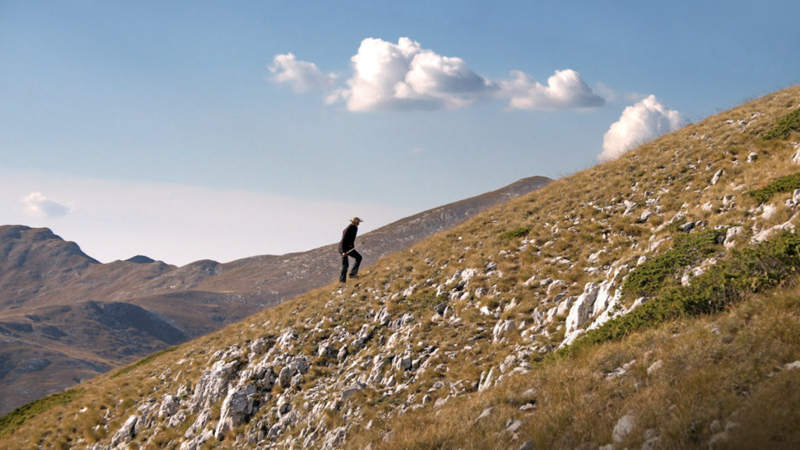
Director: Petra Seliškar
Film: The Mountain Won’t Move
The Šar Mountains, stretching across North Macedonia, are perhaps most widely known in the public consciousness for the Šarplaninac, a renowned sheepdog breed. The Šarplaninac was once known as the Illyrian Shepherd, and the ancient Illyrians were, to a large extent, the ancestors of today’s Albanians. In her film "The Mountain Won’t Move", Petra Seliškar focuses on an Albanian family of young shepherds on these mountains, dedicated to this ancient and largely vanishing profession.
The result of her cinematic engagement is not some form of "exotization," but rather an expansion of the field of perception beyond established cultural views and the "common-sense" world perspective cultivated by most members of urbanized modern civilization. Today, the countryside itself has become urbanized, insofar as it has largely turned into a dormitory for those who work in various towns and cities but cannot or do not wish to afford the high cost of living there.
The film is poetic—not merely in its lyricism, but specifically in its capacity to expand perception. Poeticism is characterized by showing the whole in a condensed form and in a new light. Within the film, diverse themes—which are usually treated separately and discursively in sociology and anthropology—intertwine organically, revealing themselves in their living wholeness.
To capture this wholeness of a way of life, the director and her crew had to sacrifice considerable comfort. According to Seliškar—with whom I spoke briefly after the screening at the Dokudoc festival—this did not exhaust her; on the contrary, it filled her with additional vitality, which is evident in the sheer power of the film.
A group of brothers, young shepherds ranging from early school age to early adulthood, are left to the natural life of the mountain, working in harsh conditions. They live in a hut where they prepare their own food and protect themselves from the rain, while their faithful canine friends guard the flock against wolves.
Through image and sound, the director captures the entire ecosystem of their mountain existence as holistically as possible. There are wide shots of mountains and pastures where the camera connects heaven and earth through shots of thunder, and low-angle shots that capture the emotional lives of the animals. Medium and wide shots capture the interpersonal dynamics in the hut or the relationships between humans and animals in the field. Sound is equally crucial. To paraphrase the director: the best way to convey the sense of magnitude that envelops us during a mountain storm is the sound of the thunder itself. The film is acoustically superb, focusing on the sounds of nature, the rain, the polyphony of animal bells, human voices, and thoughts amidst a vast silence—crackles, rustles, and whispers. In tandem with skillful editing, it recreates the unforgettable atmosphere of the Šar Mountains.
When the film speaks of nature and man’s relationship to it, it also addresses the social dimension of existence. This is its greatest quality—if it were merely a panoramic display of pastoral life and a capture of a supposedly "pre-modern" way of being where nature and society are not yet strictly divided, it would lack such weight. The implicit conflicts and social contradictions that emerge within the atmosphere and the relationships between protagonists—without being tendentiously forced to the fore or compromising the film’s poeticism—are what make it so compelling.
First, let us highlight the highly relevant theme of patriarchy, which is implied rather than explicit, yet likely arises as a question for many viewers. On one hand, we have the relationship between the director and a group of young boys in an environment largely perceived as patriarchal. At the film’s presentation in Maribor, Strban stated that the protagonists accepted her as a maternal figure, and the collaboration was excellent. Within their internal dynamics, however, patriarchy reveals itself as something quite different from the common perception that equates it with machismo.
The historical-materialist position, stemming from Engels’ early interpretations of women’s oppression, offers a different view. Patriarchy did not arise from machismo or violent male dominance, but from a new division of labor during the transition from hunter-gatherer to agricultural societies. Heavy labor in the fields required many hands, thus assigning women a reproductive role tied to the home. Agricultural civilization produced the first surpluses intended for trade which, due to men's involvement in the sphere of production, created economic inequalities. Machismo is not an inherent feature of patriarchy. On the contrary, in more patriarchal societies, one often observes less machismo and more chivalry or tender relationships among men themselves. It seems that machismo, as we know it today, arises as a pathological reaction to the decay of patriarchy, which pushes many men into uncertainty regarding their own status and identity. In the film, we see no seeds of "toxic masculinity" among the boys; instead, we see solidarity, tenderness, and care from the older for the younger. Their ways of playing and caring for the younger ones contrast with the coldness or cynicism often found in sibling relationships in urbanized lifestyles. This contrast is particularly evident in a scene where the youngest member smokes a cigarette and drinks coffee—a joke prompted by his brother. From the perspective of the clinical, detached view of human relations prevalent in modern civilization, this might seem highly inappropriate; in this context, however, it is an expression of warmth and unburdened connection.
The protagonists are neither farmers nor sedentary; they lead a semi-nomadic life which, according to historical-materialist interpretation, is anthropologically closer to societies that knew matriarchy or gender egalitarianism. The fact that they are involved in a gendered division of labor does not automatically presuppose patriarchy. Such a division was also characteristic of pre-patriarchal societies. Through this lens, the question of the pastoral profession gains new nuances.
Regarding patriarchy, it is also interesting to observe the status of animals. The agricultural patriarchal family remained an "extended" unit for a long time, until the onset of industrial capitalism. Capitalism, needing a universal competition of workers, required atomization, leading first to the nuclear family and today toward the dystopian figure of the total individual, "freed" from all social ties. It creates conditions where the family disappears and relationships become precarious (e.g., "situationships"). Yet, since such atomization is detrimental to both material survival and mental health, reverse processes occur that resemble extended families, even those of the hunter-gatherer era. "Polyamory" may seem like a shocking novelty, but it is effectively a form of extended family that aids material survival in a world of high rents. The status of animals has shifted through these stages until we reached a world where pets are part of the nuclear family while others are cruelly exploited in the food industry. With the breakdown of the family, the bond between humans and animals also shatters. The semi-nomadic pastoral life still transcends this sharp division. In the film, the flock is still treated as a tool, yet with a degree of dignity. During a rare slaughter for food, the shepherds even attribute a soul to the animal. One of the guard dogs growls at the shepherd during the slaughter, and the shepherd does not react negatively; it is as if both dogs and humans are aware of the inherent value of life. This scene preturbes our notions of simple, one-way relationships between beings.
The dogs, as a link between shepherds and the flock, play a vital role. As Strban noted, they are part of the extended family. The shepherds envision their future with the dogs in mind; they are undoubtedly subjects. The camera, often from a low-angle perspective, catches the emotional responses of the animals—especially the dogs and occasionally the goats. These scenes are the gems of the film, forming an organic whole of images, sounds, and subtle meanings.
While patriarchy and animal relations are woven in implicitly, the question of the future of the pastoral profession in a post-industrial society is a challenging one. The film could have ignored this for fear of breaking the poetic wholeness, or problematized it in a way that ruined the aesthetic harmony. Instead, it introduces the theme as subtly as the others. The threat to this world is revealed through phone calls with people off-screen and dialogues between the boys. The gravity of the question remains, yet it does not undermine the experience of authenticity.
This is the significance of the title—The Mountain Won’t Move. It is not about nostalgia or anxiety over a disappearing way of life. We feel that the beauty and majesty of nature will never vanish, regardless of social changes or the choices of these young shepherds. Even if they leave their profession and move away, the mountain will not move. It remains in its "eternal" present, a moment of enjoyment allowed by old ways of life outside the digital, postmodern hecticness. Memories will be preserved, not just by the film’s existence, but by its ability to be "in the moment" with the mountain.
This is its artistic achievement: to show a non-idyllic idyll, to show the power of tradition when facing the present without idealization. It transcends bucolic kitsch and offers a spiritual quality. It does not ignore our perception but includes it, preserving a sense of the "eternal" within a specific historical moment. It places the experience of the Šar Mountains within the totality of human experience without exotizing it.
The film is ecological in an unconventional sense: it does not cast nature as a victim but as an agent. It emphasizes nature's stasis compared to the relativity of our irrational beliefs in eternal economic growth. Nature will remain; the question is whether civilization will. The film does not close with a direct message, but remains implicit throughout. Unpretentious, yet deeply revitalizing.
Muanis Sinanović